


Successful Cases

Fair Compensation for a Pickup Truck Injury
Despite a complex liability dispute, I secured the maximum policy limits for a client who suffered a traumatic injury after being thrown from the back of a pickup truck.
Fair Compensation for a Pickup Truck Injury
Despite a complex liability dispute, I secured the maximum policy limits for a client who suffered a traumatic injury after being thrown from the back of a pickup truck.
Car Accident Coverage Saved from False Cancellation
I won against an insurance company that tried to wrongfully deny coverage by falsifying documents, getting my client's policy reinstated and her claim paid in full.
Car Accident Coverage Saved from False Cancellation
I won against an insurance company that tried to wrongfully deny coverage by falsifying documents, getting my client's policy reinstated and her claim paid in full.
Rejected Car Accident Claim Wins Full Settlement
I overturned a liability denial on a case other lawyers rejected, securing the full policy limits for a client severely injured in a major collision.
Rejected Car Accident Claim Wins Full Settlement
I overturned a liability denial on a case other lawyers rejected, securing the full policy limits for a client severely injured in a major collision.
%20(1).avif)

Applewhite
Leander's Growth Put Trucks and Traffic On a Collision Course
Leander grew fast, and the roads didn't keep pace. Tanker trucks, box trucks, and 18-wheelers now share 183A, RM 1431, and Hero Way with daily commuter traffic, and when one of them hits a passenger vehicle, the outcome is rarely a fender bender. It's broken bones, a totaled car, and a trucking company's claims adjuster calling before you've left the hospital.
I'm Ashley Applewhite. Before I represented injured people, I represented the insurance side of cases like this one — commercial carriers, corporate defendants, the companies with the deep pockets and the fast-moving legal teams. I know the sequence they follow after a crash because I used to help build it. Now I use that same knowledge against them, on behalf of people hurt in Leander.





The Laws Behind a Leander Truck Accident Claim
Truck cases run on a different set of rules than an ordinary car wreck, and knowing them shapes how a claim gets built from the first phone call.
Commercial drivers and carriers answer to the Federal Motor Carrier Safety Administration, which limits driving time to 11 hours within a 14-hour on-duty window, requires electronic logging of those hours, and sets minimum liability insurance for interstate carriers — often $750,000 and up, more for trucks hauling hazardous materials. A violation of any of these rules is strong evidence of negligence.
Texas law also lets an injured person hold the trucking company itself responsible for a driver's conduct, not just the driver, when the driver was acting within the scope of employment. Separate claims can reach the company directly for negligent hiring, inadequate training, or ignoring known maintenance problems.
Two more rules shape almost every case: Texas's two-year statute of limitations on personal injury claims, and its modified comparative negligence rule, which reduces — but doesn't eliminate — a recovery when the injured person shares some of the fault. Both are covered in more detail below.
A Truck Wreck in Leander Puts You On the Clock Immediately
Evidence starts disappearing the moment the tow trucks leave. Call or text now so I can get a hold letter out before anything gets lost.
What Causes Truck Crashes in Leander
Most truck wrecks trace back to a handful of recurring problems, and more than one is often at play in the same crash:
- Fatigue and scheduling pressure. Federal rules cap how many hours a driver can spend behind the wheel, but a tight delivery window or an understaffed carrier can push a driver past the point of safe reaction time anyway.
- Distraction. A phone, a dispatch screen, a moment of attention pulled off the road looks the same in a truck cab as in any other vehicle, except the stopping distance for an 80,000-pound rig makes that moment far less forgiving.
- Speed and following distance. A loaded tractor-trailer needs significantly more room to stop, and a driver who misjudges that gap on 183A or through a construction zone on RM 1431 often can't correct in time.
- Cargo and mechanical failures. Freight that wasn't properly secured shifting mid-drive, brakes or tires overdue for service, or a carrier that skipped a required inspection to keep a truck on the road.
Types of Truck Accidents I Handle in Leander
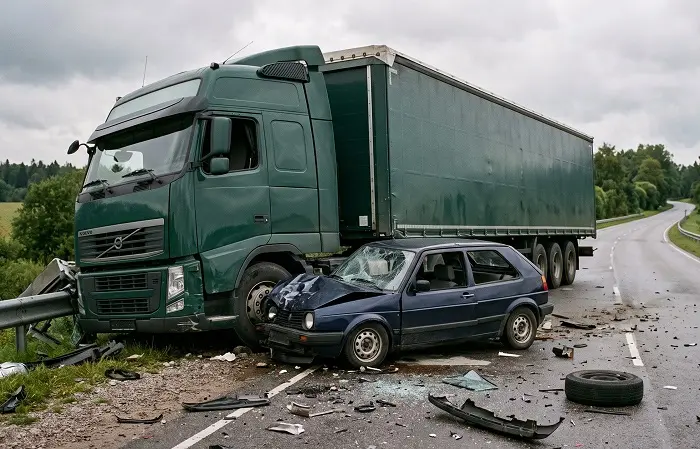
Commercial vehicle crashes take a handful of recognizable shapes, and the shape often points straight to who was at fault:
- Jackknife accidents, where the trailer swings out from the cab, usually tied to sudden braking, speed, or poor road conditions;
- Underride collisions, where a passenger vehicle slides beneath a trailer's side or rear — among the deadliest crash types on the road;
- Wide-turn wrecks, common on Leander's surface streets where a truck cuts into an adjacent lane to complete a turn;
- Blind-spot and lane-change collisions, when a driver merges without checking a truck's large no-visibility zones;
- Rear-end and rollover crashes, often linked to following too closely, overloaded cargo, or fatigue;
- Cargo-shift accidents, where improperly secured freight throws off a trailer's balance mid-drive;
- Side-impact and T-bone collisions at intersections along 183A and RM 1431.
Every one of these requires a different evidentiary approach, and I build the case around the specific mechanics of your crash rather than a generic template.
Injuries from Leander Truck Crashes
A loaded commercial truck can weigh twenty to thirty times what a passenger car weighs. That imbalance shows up in the injuries I see most often in these cases:
- Traumatic brain injuries, from mild concussions to lasting cognitive and memory problems;
- Spinal cord damage, including partial or complete paralysis;
- Crush injuries from cab intrusion or being pinned between vehicles;
- Multiple fractures requiring surgical hardware and extended rehabilitation;
- Internal organ damage and internal bleeding that isn't always obvious right away;
- Burn injuries from fuel or cargo fires;
- Permanent disfigurement and amputation;
- Wrongful death, when a family loses someone in the crash.
Medical treatment for injuries like these often stretches across months or years, and a claim needs to account for all of it — not just the first ER bill.
.avif)
Talk to Ashley Applewhite Before You Talk to the Insurance Company
A short call now can protect a case for months. I'll walk through what happened, what needs to be preserved, and what your options look like — at no cost.
Why Choose Applewhite Firm PLLC for Your Leander Truck Accident Case
.svg)
Insider Read on How Insurers Build Their Case
Years spent defending insurance carriers taught me exactly how they build a file against an injured person. I use that same knowledge to build yours.
.svg)
Direct Access to Your Attorney
You work with me, not a rotating cast of paralegals. I handle the investigation, the negotiation, and — if it comes to that — the litigation personally.
.svg)
No Fee Unless I Recover for You
These cases are handled on contingency, with no upfront cost for the initial review.
.svg)
24/7 Availability
A truck wreck doesn't wait for business hours, and neither do I.
How I Handle Your Case
I Secure the Evidence Before It Disappears
Trucks carry logging devices and event data recorders that show speed, braking, and hours driven, but carriers aren't required to keep that data long, and some systems overwrite it within days. I send a preservation letter the moment I'm retained, before any of it can vanish.
I Trace Liability Past the Driver
A truck wreck rarely comes down to one person's mistake. Fault can fall on the trucking company for hiring or scheduling failures, a cargo loader for freight that wasn't secured, a maintenance contractor for deferred repairs, or a broker who dispatched an unsafe carrier.
I Anticipate the Insurer's Playbook
Commercial carriers move fast, and that usually means a recorded-statement request framed as routine, a lowball offer sent before your treatment is finished, an argument that you share the blame, or a dispute over whether your injuries came from this crash at all.
I Fight for the Full Value of Your Claim
Texas law allows recovery for medical treatment, lost income and reduced earning capacity, property damage, pain and the disruption to daily life, and wrongful death damages where applicable. I build the case around all of it, not just what the adjuster offers first.
A Leander Truck Wreck Doesn't Wait — Neither Should Your Call
The company that owns that truck already has people working on its defense. Reach out before more of the evidence you need disappears.
FAQ: Truck Accident Claims in Leander, TX
How long do I have to bring a truck accident claim in Texas?
Generally, two years from the date of the crash, under Texas Civil Practice and Remedies Code § 16.003. The deadline for filing suit is fixed, but the evidence that wins or loses the case — the black box data, the driver logs — has a much shorter shelf life. Waiting to see a lawyer is riskier than the two-year window suggests.
The trucking company's insurer already called me. Did I make a mistake talking to them?
Not necessarily, but be careful going forward. A short conversation acknowledging the crash happened is different from a recorded statement about how it happened, your injuries, or who was at fault. If they ask to record you or want a written statement, hold off until we've spoken.
Who can actually be held responsible for a truck accident?
More parties than most people expect. Beyond the driver, liability can extend to the trucking company, a cargo loading company, a maintenance contractor, a parts manufacturer, or a freight broker, depending on what caused the crash. Sorting this out is a core part of the investigation I run on every case.
My injuries seemed minor at first but got worse over the following week. Is that a problem for my claim?
It's common, particularly with back, neck, and head injuries — adrenaline and inflammation can mask symptoms for days. What matters is getting evaluated promptly once symptoms appear and making sure it's documented. Don't sign anything from an insurer until that picture is clear.
What does it cost to have you look at my case?
Nothing up front. I work on a contingency fee, which means I only get paid if I recover compensation for you. The initial case review is free regardless of what you decide afterward.
